
Introducing True Origin: Stop Getting Duped by Inaccurate HQ Locations While Trading

One of the most common things I hear traders say after a violent stock dump is:
“I wouldn’t have touched it if I had known it was a Chinese pump & dump.”
On the surface, many of these companies appear harmless. A quick search may show a headquarters in Delaware or other common US corporate jurisdiction. Nowadays that can bait you into a false sense of security - which is entirely these questionable businesses objective.

The real question traders should be asking is:
Where does the business actually operate?
That is what MOMO Pro’s new True Origin engine is designed to uncover.
What True Origin Does
True Origin uses AI-powered forensic analysis to compare a company’s registered headquarters against its actual operating footprint.
Instead of relying only on the SEC cover page or a quick Google result, True Origin reviews filings such as 20-Fs, F-1s, 6-Ks, and related disclosures to identify where the company’s executives, assets, revenue, factories, subsidiaries, and operating entities are actually located.

The purpose of True Origin is to help traders quickly understand when a U.S.-listed stock may carry elevated foreign operating, ownership, audit, or enforcement risk.
This does not mean every foreign-operated company is bad, but it does mean that traders should know what they are actually trading before chasing a fast-moving stock.
Why This Matters
Many high-risk microcaps are structured in ways that make the registered HQ look very different from the true operating reality.
A stock may appear to be registered in a familiar offshore or U.S. jurisdiction, while the actual business, management team, assets, and revenue generation are tied to mainland China, Hong Kong, or another foreign jurisdiction.
And if you found this post because you have been burned in the past, you know that difference matters.
It can affect:
- Audit transparency
- Enforcement risk
- Shareholder rights
- Ultimate beneficial ownership visibility
- Float control
- Reporting accuracy
- Regulatory exposure
- The likelihood of sharp, unexpected drops
When a stock is moving fast, traders often do not have time to manually read filings. True Origin is designed to surface that risk quickly.
Forensic Analysis: True Origin vs. Registered HQ
The True Origin engine focuses on what we call the Jurisdictional Difference.
That is the gap between:
1. Registered HQ
The company’s official address listed on the SEC cover page or corporate registration.
2. True Origin
The actual location of the company’s operations, executives, assets, subsidiaries, factories, revenue generation, and business control.
In many high-risk microcaps, this difference can be meaningful. Sometimes the registered HQ is a legal shell, while the real business sits somewhere else entirely.
That is the risk True Origin is built to expose.
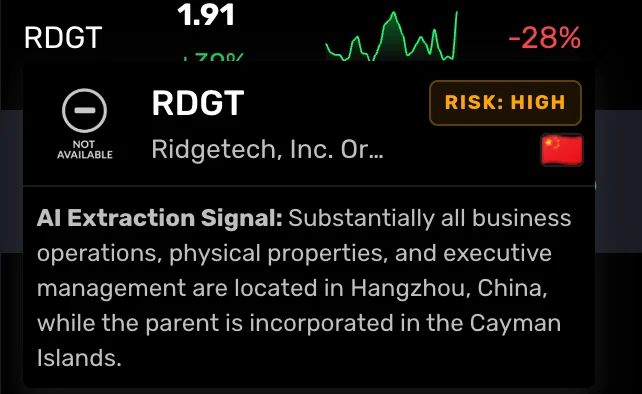
Use Case 1: Sino-Cayman Contractual Shells
One of the most common structures True Origin identifies is the offshore holding company model, often involving Cayman Islands or British Virgin Islands entities.
These companies may use Variable Interest Entity structures, Wholly Foreign-Owned Enterprise arrangements, or similar contractual frameworks.
The pattern often looks like this:
Registered HQ:
Cayman Islands, British Virgin Islands, or another offshore jurisdiction.
True Operating Location:
Mainland China, Hong Kong, or another foreign operating base.
Why it matters:
U.S. shareholders may not directly own the underlying operating business. In some cases, they own shares in an offshore holding company that has contractual rights tied to the operating entity.
That creates a very different risk profile than owning equity in a traditional U.S.-based operating company.
If those contractual arrangements break down, become unenforceable, or face regulatory pressure, the public equity can be exposed to severe downside.
Examples of structures True Origin is designed to flag include companies where the SEC-registered jurisdiction differs materially from the physical operating footprint disclosed in filings.
Use Case 2: Offshore Anonymity and Ownership Obfuscation
Another pattern involves layered offshore ownership structures that make it difficult to understand who truly controls the company.
In these cases, the issue is not just where the business operates. It is also who controls the float, who controls the holding entities, and how transparent the ownership structure really is.
A company may appear to have a clean registration profile, but deeper filing analysis may reveal multiple layers of offshore entities, nominee structures, or holding companies that obscure ultimate beneficial ownership.
For traders, this can matter because tightly controlled floats can create extreme price behavior.
These stocks may move sharply higher on thin liquidity, only to collapse just as violently when liquidity disappears.
True Origin helps identify when the corporate structure itself may be part of the risk.
Use Case 3: Audit Location and PCAOB Conflict Risk
True Origin also evaluates audit geography.
The important question is not only which audit firm is listed, but where the audit work is actually being performed and whether the relevant audit office is subject to proper inspection.
A familiar audit brand does not automatically eliminate risk if the underlying assets and operations are located in a jurisdiction with limited inspection visibility.
True Origin helps traders identify potential mismatches between:
- The listed auditor
- The signing office
- The location of the company’s assets
- The jurisdiction of the operating business
- PCAOB inspection visibility
This can help surface situations where the financial statements may carry elevated internal control or verification risk.
Why We Built It
MOMO Pro is built to help traders move faster while staying aware of risk. Having been personally caught by these shady entities made us acutely aware of how easy it was to get misled.
Momentum trading often attracts the most speculative stocks in the market. These names can produce massive intraday moves, but they can also produce sudden, violent dumps.
Unfortunately we only discover the real operating location after the damage is done wondering how the trade went so wrong. We screen and find the move, see a U.S. listing or don't even look due to the challenge of finding details and assume the risk is manageable.
Then the stock collapses.
True Origin is designed to give traders one more layer of defense before entering these types of trades.
True Origin does not tell you what to buy or sell nor does it entirely eliminate risk. It does help you understand when the stock in front of you may not be what it appears to be.
Built Into MOMO Pro
Over the past several weeks, we analyzed the U.S.-listed market using SEC filings and AI to refine the True Origin scoring system. This required parsing over 5Gb of filings and honing the analysis to give the most accurate risk assessment possible.
The result is a new MOMO Pro capability that gives traders a faster way to evaluate foreign operating risk, registered HQ discrepancies, and other red flags.
When a stock is moving quickly, you may still decide to trade it.But now you can do it with a clearer view of what you are actually dealing with. Because sometimes the headquarters listed on the screen is not the true origin of the risk.
True Origin is now exclusively available in all MOMO Pro plans.